
The Anatomy of a diamond

The parts of a diamond
Diameter: The width of a polished diamond, measured from one edge of the girdle to the other.
Table: The largest polished facet of the diamond, crowning the top of the stone.
Crown: The upper portion of the diamond, measured from the table to the girdle.
Girdle: The widest edge of the diamond, where the crown ends and the pavilion begins.
Pavilion: The lower portion of the diamond, beginning at the girdle and extending to the culet.
Culet: The diminutive flat facet at the lowest point of the stone.
Depth: The total height of the diamond, measured from the culet to the table.
The 4Cs of diamonds
The value and quality of a natural diamond are determined by the combination of four distinct parameters, known as the 4Cs: carat weight, clarity, colour and cut.
These are the principal criteria by which the diamond industry assesses a stone’s physical attributes.

01 Carat Weight
Carat refers to the weight of a diamond. Contrary to popular belief, carat weight is not directly related to a diamond’s size. It is the foremost determinant of a diamond’s value: the greater the weight, the greater the value. That said, two diamonds of identical size can differ considerably in worth, as quality plays a decisive part.
By way of example, one carat is equal to 0.20 grams and is divided into 100 “points”. A diamond of 25 points therefore corresponds to a quarter of a carat, or 0.25 carats.

02 Clarity
Clarity is the term used to describe the impurities that occur naturally within diamonds. These are minute traces of uncrystallised carbon: tiny marks or blemishes found inside the stone or on its surface.
Known as inclusions, they determine the stone’s clarity. They are, in essence, nature’s own fingerprints, which make each diamond unique.
Virtually every diamond contains inclusions to a greater or lesser degree. Most are imperceptible to the naked eye and can only be appreciated under a microscope.
Depending on the crystallisation process, a diamond will present fewer or more inclusions. The more inclusions a diamond holds, the more obstacles light meets as it passes through it. Conversely, the fewer the inclusions, the more light enters the stone, and the greater the brilliance it radiates.
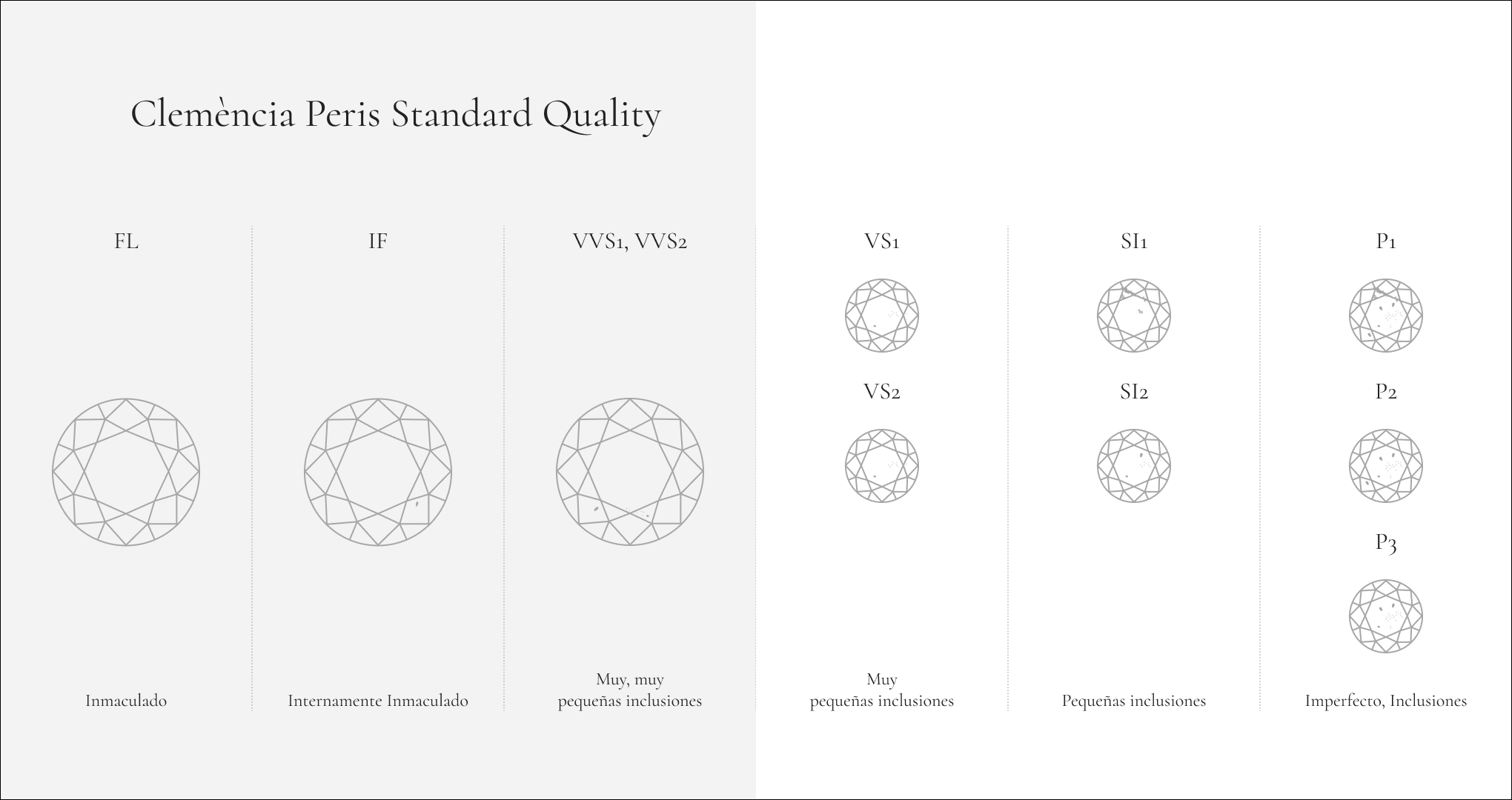
The Diamond Clarity Scale
A diamond’s clarity is graded across six ranges, ordered from highest to lowest quality.
| Clarity grade | Meaning | Description |
|---|---|---|
| FL, IF | Flawless / Internally Flawless | Flawless diamonds show no inclusions or blemishes detectable under 10x magnification and are exceedingly rare. Internally Flawless diamonds show no detectable inclusions under 10x magnification; they are rare and highly prized. |
| VVS1/VVS2 | Very, Very Slightly Included | Inclusions and blemishes that are extremely difficult for an expert grader to detect under 10x magnification. |
| VS1/VS2 | Very Slightly Included | Inclusions and blemishes detectable under 10x magnification. These are minor imperfections that have no bearing on the diamond’s beauty and are generally invisible to the naked eye. |
| SI1/SI2 | Slightly Included | Inclusions and blemishes readily apparent under 10x magnification and, in some cases, visible to the naked eye. |
| P1, P2, P3 | Imperfect / Included | Inclusions and blemishes that are conspicuous under 10x magnification and generally visible to the naked eye as well. Such imperfections may compromise the stone’s transparency and brilliance. |
At Clemència Peris, we work exclusively with diamonds in the VVS1–VVS2 or VS1–VS2 ranges. These are regarded as the finest grades in the world of high jewellery. Any diamond above this classification is destined directly for auction.

03 Colour
A diamond’s colour refers to the degree of tint the stone may display. A white diamond may be entirely colourless, and therefore of the very highest quality, or it may carry a yellowish cast. This should not be confused with fancy yellow diamonds.
The absence of colour allows light to pass cleanly through a diamond and break into a rainbow of colours, as through a prism, yielding exceptional light and brilliance.
The international colour scale is divided into grades according to the intensity of tint, designated by letters from D to Z. They may be grouped as follows:
| Colour grade | Meaning | Description |
|---|---|---|
| D | Colourless Exceptional white, 100% colourless | The highest colour grade a diamond can receive. D-colour diamonds are exceedingly rare and command a very high price. |
| E, F | Colourless Exceptionally transparent | It is extremely difficult to detect any trace of colour in a diamond graded E or F. These diamonds are rare and carry a high price. |
| G, H | Near Colourless | Unless set beside a high-grade master stone, colour is virtually impossible to detect. The diamond appears completely colourless when viewed face-up. These diamonds are still rare, though slightly less costly, and are considered of great value. |
| I, J, K, L, M | Faint Yellow | The colour of these diamonds is slightly visible. Once the stone has been set, the faint tint is imperceptible to the naked eye. |
| N – Z | Light Yellow and Very Light Yellow | The colour is discernible. These diamonds are not suited to sale as gem-quality stones. |
At Clemència Peris, we select only diamonds in the range from D to H: exceptional white, rare white and white. The GIA designates this range as River, Top Wesselton and Wesselton quality, the only grades that guarantee a magnificent colour to the naked eye.
Any diamond of a lower grade, with a more pronounced tint, we set aside, as it cannot ensure the desired brilliance and falls short of the house’s standards of quality.


04 Cut
Of the 4Cs, cut is the only one determined by the human hand; the other three are dictated by nature itself.
Cut refers to the way in which a stone has been shaped and faceted to enhance its brilliance, and it governs how intensely light is reflected. It is, in other words, the decisive parameter in the stone’s optical appearance.
The skill of the cutter has a fundamental influence on a diamond’s brilliance, for a diamond captures light according to how it has been cut:
- When a diamond is cut to the right proportions, light travels from facet to facet until it is released through the top of the stone, delivering the greatest possible brilliance.
- When a diamond is cut too deep, part of the light escapes through the opposite side of the pavilion or through the base. The brilliance it projects is somewhat diminished.
- When a diamond is cut too shallow, light is lost before it can be reflected, and the resulting brilliance is scant.
The quality of a diamond’s cut is graded on several levels by laboratories such as the Gemological Institute of America. This assessment analyses how light interacts with the stone.
| Cut grade | Description |
|---|---|
| Excellent | The highest grade of cut. Outstanding performance in light. Returns almost all the light that enters the stone. Uncommon and exceptionally beautiful cuts. The diamond has been cut to perfect proportions and angles that maximise brilliance. Light enters the stone and is reflected to ideal effect. |
| Very good | A cut of very high quality. Very fine performance in light. There may be a slight deviation in proportions, yet the brilliance it reflects is truly fine. Returns almost all the light that enters the stone. Very Good cut diamonds are considered of great value. |
| Good (buena) | Good performance in light. The diamond reflects most of the light that enters it, though not all, as some escapes through the sides or the base. Good cut diamonds are considerably less costly than Very Good. The brilliance is slightly diminished. |
| Fair | The diamond displays limited luminosity owing to unbalanced proportions. Less brilliant than the grades above, though still regarded as diamonds of acceptable quality. |
| Poor | The diamond has not been well cut and has unfavourable proportions. Generally cut either too shallow or too deep, so that a great deal of light escapes through the sides and the base. Light fails to reflect properly, and the brilliance is greatly reduced. |
At Clemència Peris, we work only with Excellent and Very Good cuts. The other grades considerably diminish a diamond’s brilliance and, in turn, its quality. The quality of the cut does not refer to the diamond’s shape (brilliant, princess, oval…) but to the precision with which it has been cut to return light. Two diamonds of the same shape can display very different brilliance.

The cut of a diamond bears directly on three principal characteristics:
- Brilliance: The total amount of light reflected by a diamond. When light strikes the surface of a diamond, part of it enters the stone and part is reflected. The light reflected most immediately is returned by the angles of the crown.
- Scintillation: Scintillation refers to the flashes of light that appear as the diamond is tilted from side to side. Light that is not immediately reflected enters the diamond and is cast by its inner walls towards the centre of the stone. This light, rebounding within the diamond, is the quality known as scintillation.
- Fire: Fire refers to the dispersion of light into the colours of the spectrum. Once light has rebounded from the walls towards the centre of the diamond, it returns swiftly to the top of the stone. Because the light is slightly bent as it passes through the diamond, a spectrum of colour can be seen emanating from the crown.
Diamond Shapes
Types of diamond shape
The shape of a diamond is the silhouette the stone presents. Among the best known are:
- Round Brilliant: The round diamond with 58 facets. It is the best-known cut and the most widely used in high jewellery. Its proportions and symmetry are perfected to maximise a diamond’s brilliance and fire.
- Oval: An elongated adaptation of the brilliant cut. It offers a high degree of brilliance, although where the stone is poorly cut, there is a strong likelihood of a dark band across its centre.
- Marquise: Like the oval, but with two pointed ends. The marquise is said to have been inspired by the mouth of the beautiful Marquise de Pompadour. Its form resembles a rugby ball, tapering to a point at either end. This shape maximises the appearance of a larger diamond and offers a high degree of brilliance and light reflection.
- Heart: The romantic cut par excellence. The corners may show traces of colour. We therefore always recommend choosing diamonds of H colour or higher to compensate.
- Emerald: A rectangular diamond with facets along all its edges and angles. Although the emerald cut is not as brilliant as the round or princess, it is regarded as an elegant cut, classic in style and less “showy” than other shapes.
- Pear: A combination of the round and marquise shapes. Also known as the teardrop, for its rounded base and tapering sides that converge in a single point.
- Princess: The square-cut diamond, displaying the same high degree of brilliance as the round brilliant.
Diamond Certification

Certified natural diamonds
Clemència Peris jewels are crafted from natural diamonds of the highest quality and exceptional brilliance.
Our master jewellers select each diamond with great care, evaluating its characteristics and parameters to create pieces that meet the most exacting standards of quality and beauty.
Every one of our diamonds is certified by the world’s most renowned gemological institutes, guaranteeing its authenticity and provenance.
With each jewel, we provide a Certificate of Authenticity attesting to its quality and characteristics.
We issue four types of certificate, depending on the diamonds the jewel contains:
| GIA Certificate | IGI Certificate | HRD Certificate | Clemència Peris Certificate |
|---|---|---|---|
| Issued by the Gemological Institute of America. Recognised worldwide as the foremost institute in gemology, and the largest non-profit organisation of its kind, based in the United States. It independently certifies the quality of diamonds, assessing the 4Cs and providing precise information on their proportions and rarity. It is considered one of the most rigorous and reliable certificates in the industry. | Issued by the International Gemological Institute. One of the most renowned gemological laboratories internationally, headquartered in Antwerp. It is the largest independent laboratory providing grading and appraisal of diamonds and fine jewellery. IGI takes pride in being the only international certification laboratory under the ownership and control of a single central governing body, ensuring the consistency of its grading reports worldwide. This certificate provides a complete and independent analysis of diamonds and is especially valued in Europe and Asia. | Hoge Raad voor Diamant (Diamond High Council). Based in Antwerp, the world capital of diamonds, it offers certification of the utmost precision. | Issued by the house for diamonds of less than 0.30 carats. An expert assessment carried out by our in-house gemmologists. It attests to the diamond’s authenticity, quality and provenance according to our exclusive high jewellery criteria, lending the stone the endorsement and prestige of the house. |